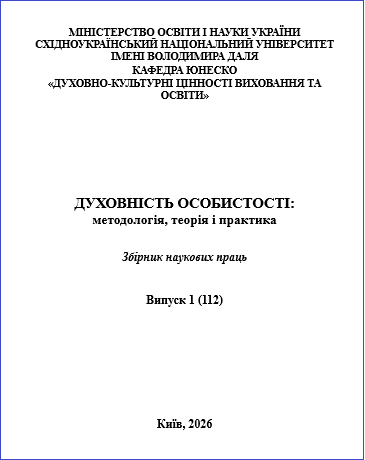
Rethinking teacher education for gifted students: german experience and ukrainian perspectives
DOI:
https://doi.org/10.33216/2220-6310/2026-112-1-70-81Keywords:
giftedness, talent development, teacher education, Leistung macht Schule (LemaS), Munich Model of Giftedness, Actiotope Model, underachievement, inclusive education, Ukraine, GermanyAbstract
This theoretical and comparative review examines contemporary approaches to teacher preparation for giftedness and talent development. It traces the conceptual evolution from psychometric selection models to dynamic, inclusive, and systemic concepts of talent development (J. Renzulli, R. Sternberg, A. Ziegler & H. Stoeger, K. Heller & C. Perleth). Particular attention is paid to Germany’s experience, specifically the federal-state initiative “Leistung macht Schule” (LemaS) and the Karg-Stiftung projects, including the William Stern Programme, which together illustrate a shift from a pedagogy of selection to a pedagogy of potential development within mainstream schools. These findings are contextualised within Ukrainian wartime realities, highlighting the risk of hidden underachievement caused by stress, trauma, and displacement. The study argues for the complementary nature of international and Ukrainian educational practices, identifying the Junior Academy of Sciences of Ukraine, the national contest and olympiad movement, and crisis-driven adaptive digital practices as valuable contributions to the global discourse on talent development. Strategic directions for rethinking teacher education in Ukraine are outlined, focusing on diagnostic competence, support for self-regulated learning, and the identification of untapped potential under adverse conditions.
References
1. Heller, K. A., Perleth, C., & Lim, T. K. (2005). The Munich Model of Giftedness designed to identify and promote gifted students. In R. J. Sternberg & J. E. Davidson (Eds.), Conceptions of Giftedness (2nd ed., pp. 147–170). Cambridge University Press.
2. Junior Academy of Sciences of Ukraine. (n.d.). JAS.Ukraine. https://man.gov.ua/en
3. Kabanets, M. M. (2019). Pedahohichna pidtrymka obdarovanykh shkoliariv: skhidnoukrainskyi dosvid [Pedagogical support for gifted schoolchildren: Eastern Ukrainian experience; Monograph]. ISBN 978-966-377-225-7. DVNZ “DonNTU”.
4. LemaS Forschungsverbund. (2026, July 23). LEMAS Forschungsverbund - Startseite. Offizielle Website Des LemaS – Forschungsverbunds. https://lemas-forschung.de/
5. Mriia is a state educational ecosystem for students, parents, and educators. (n.d.). https://mriia.gov.ua/en/app
6. OECD. (2025). Teacher Professional Learning: Drawing Upon International Practice for a Future Vision for Ukraine. OECD Publishing. https://doi.org/10.1787/0cceeddf-en
7. Qin, X., Xiao, G., & Lv, L. (2026). Which career cycle might facilitate students’ development following teachers’ gifted education training? Frontiers in Psychology, 17, 1813855. Qin, X., Xiao, G., & Lv, L. (2026). Which career cycle might facilitate students’ development following teachers’ gifted education training? Frontiers in Psychology, 17, 1813855. https://doi.org/10.3389/fpsyg.2026.1813855
8. Reis, S. M., & McCoach, D. B. (2000). The underachievement of gifted students: What do we know and where do we go? Gifted Child Quarterly, 44(3), 152–170. https://doi.org/10.1177/001698620004400302
9. Renzulli, J. S. (1990). A practical system for identifying gifted and talented students. Early Childhood Development, 63(1), 9–18. https://doi.org/10.1080/0300443900630103
10. Sternberg, R. J. (2024). A duplex model for giftedness. Roeper Review, 46(1). https://doi.org/10.1177/00169862231217730
11. Sternberg, R. J., Chowkase, A., Desmet, O., Karami, S., Landy, J., & Lu, J. (2021). Beyond transformational giftedness. Education Sciences, 11(5), 192. https://doi.org/10.3390/educsci11050192
12. Tillmann, K.-J. (2020). Das Schulsystem in Deutschland: Strukturen, Prozesse, Reformen (2. Aufl.). Klinkhardt.
13. UNESCO. (2025, November 25). Standing with Ukraine's teachers: How UNESCO supports educators in times of war. https://www.unesco.org/en/articles/standing-ukraines-teachers-how-unesco-supports-educators-times-war
14. UNICEF. (2026, February 17). More than a third of Ukraine’s children remain displaced four years into the war – UNICEF [Press release]. https://www.unicef.org/ukraine/en/press-releases/more-third-ukraines-children-remain-displaced-four-years-war-unicef
15. Weigand, G., Fischer, C., Käpnick, F., Perleth, C., Preckel, F., Vock, M., & Wollersheim, H.-W. (Eds.). (2022). Dimensionen der Begabungs- und Begabtenförderung in der Schule: Individuelle Potenziale entwickeln – Institutionelle Standards sichern (LemaS). Waxmann. https:// doi.org/10.3278/9783763967858
16. World Bank. (2025, March 25). Learning and school reforms continue in Ukraine despite war challenges. https://www.worldbank.org/en/news/feature/2025/03/25/learning-and-school-reforms-continue-in-ukraine-despite-war-challenges
17. World Council for Gifted and Talented Children. (2021). Global principles for professional learning in gifted education. https://world-gifted.org/wp-content/uploads/2022/01/professional-learning-global-principles.pdf
18. Ziegler, A. (2005). The Actotope Model of Giftedness. In R. J. Sternberg & J. E. Davidson (Eds.), Concept of giftedness (2nd ed., pp. 411–434). Cambridge University Press. https://doi.org/10.1017/CBO9780511610455.022
19. Ziegler, A., & Stoeger, H. (2017). Systemic gifted education: A theoretical introduction. Gifted Child Quarterly, 61(3), 183–193. https://doi.org/10.1177/0016986217705713