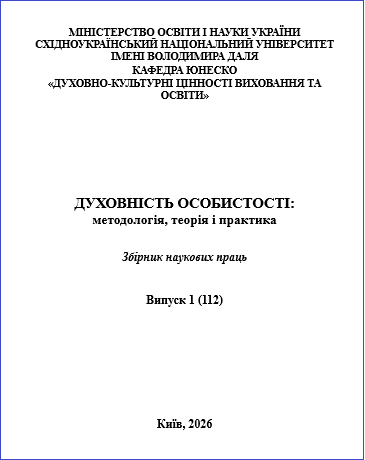
Author–reader interaction in english-language academic texts
DOI:
https://doi.org/10.33216/2220-6310/2026-112-1-147-156Keywords:
English-language academic text, academic writing, author-reader interaction, metadiscourse, authorial stance, reader engagement, university studentsAbstract
The article examines author-reader interaction as a defining feature of English-language academic texts. It proceeds from the premise that authors do more than report research findings: they also regulate the strength of their claims, establish their position and anticipate readers’ responses. The aim is to characterise this interaction through the resources used to express authorial stance and engage readers, and to propose ways of addressing them in teaching English academic writing. Authorial stance is conveyed through hedges, boosters, attitude markers and self-mentions. These resources allow authors to align the strength of a claim with the available evidence and indicate their responsibility for its content. Reader engagement is achieved through reader pronouns, directives, questions, appeals to shared knowledge and personal asides, which guide readers’ attention and facilitate their understanding of the argument. The effectiveness of these resources depends not on how frequently they occur, but on their appropriateness to the genre, evidential basis and writer’s communicative intention. A three-stage sequence is proposed for teaching author-reader interaction: functional observation, guided transformation and independent text revision. At the first stage, students compare alternative formulations of claims with the same propositional content. At the second, they adjust the degree of commitment and the manner of addressing readers to a given rhetorical situation. At the third, students write and revise their own academic paragraph. The assessment criteria include alignment between claims and evidence, clarity of authorial stance, coherence of argumentation and accessibility of the text to its intended reader.
References
1. Appel R., McKay R. The value of interactional metadiscourse in university level writing: Differences between high and low performing undergraduate business students. English for Specific Purposes. 2025. Vol. 79. P. 30–42. DOI: https://doi.org/10.1016/j.esp.2025.03.002
2. Dontcheva-Navratilova O. Engaging with the reader in research articles in English: Variation across disciplines and linguacultural backgrounds. English for Specific Purposes. 2021. Vol. 63. P. 18–32. DOI: https://doi.org/10.1016/j.esp.2021.02.003
3. El-Dakhs D. A. S., Yahya N., Pawlak M. Investigating the impact of explicit and implicit instruction on the use of interactional metadiscourse markers. Asian-Pacific Journal of Second and Foreign Language Education. 2022. Vol. 7. Article 44. DOI: https://doi.org/10.1186/s40862-022-00175-0
4. Ho V., Li C. The use of metadiscourse and persuasion: An analysis of first year university students’ timed argumentative essays. Journal of English for Academic Purposes. 2018. Vol. 33. P. 53–68. DOI: https://doi.org/10.1016/j.jeap.2018.02.001
5. Hyland K. Metadiscourse: What is it and where is it going? Journal of Pragmatics. 2017. Vol. 113. P. 16–29. DOI: https://doi.org/10.1016/j.pragma.2017.03.007
6. Hyland K., Jiang F. K. Metadiscourse choices in EAP: An intra-journal study of JEAP. Journal of English for Academic Purposes. 2022. Vol. 60. Article 101165. DOI: https://doi.org/10.1016/j.jeap.2022.101165
7. Ivanytska N., Paslavska I. Approximation as a linguistic hedging tactic in academic discourse: Interlingual aspect. Folium. 2024. № 4. P. 106–112. DOI: https://doi.org/10.32782/folium/2024.4.15
8. Lee J. J., Deakin L. Interactions in L1 and L2 undergraduate student writing: Interactional metadiscourse in successful and less-successful argumentative essays. Journal of Second Language Writing. 2016. Vol. 33. P. 21–34. DOI: https://doi.org/10.1016/j.jslw.2016.06.004
9. Sun S. A., Jiang F. K. Analyzing metadiscourse in L2 writing for academic purposes: Models and approaches. Research Methods in Applied Linguistics. 2024. Vol. 3, № 3. Article 100149. DOI: https://doi.org/10.1016/j.rmal.2024.100149