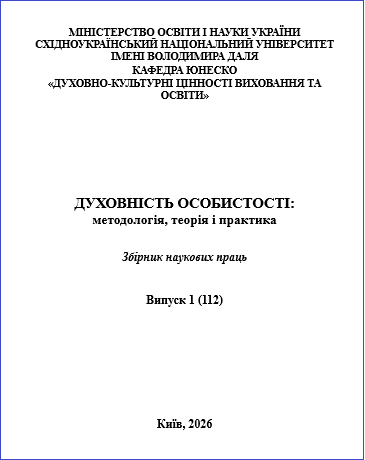
Educational research laboratory for future preschool teachers: theoretical foundations and modern technologies
DOI:
https://doi.org/10.33216/2220-6310/2026-112-1-196-213Keywords:
future preschool educator, preschool education teacher, research competence, research culture, educational research laboratory, research activity, professional training, inquiry-based learning, innovative educational technologies, preschool educationAbstract
The article addresses the issue of developing the research culture of future preschool educators as an essential component of their professional training. It emphasizes that a contemporary preschool teacher should possess not only professional knowledge and practical skills but also research competencies that enable the analysis of pedagogical phenomena, the identification of effective solutions to professional challenges, and the implementation of innovations in the educational process.
Research competence of a preschool educator is defined as an integrative construct encompassing motivation for scientific inquiry, a system of theoretical knowledge, research skills, and personal qualities required for conducting educational research. It is argued that the development of this competence is facilitated through the ability to identify research problems, justify their relevance, formulate research aims and objectives, select appropriate research methods, analyse research findings, and effectively present the results.
Particular attention is devoted to the educational research laboratory of the future preschool educator as an innovative environment for fostering students’ research competencies. Specifically, the paper highlights the application of contemporary educational technologies within the educational research laboratory Spiritual Foundations of Early Childhood as a means of developing research competence, creative thinking, and professional readiness among future preschool educators. The educational potential of project-based, blended, and distance learning technologies, digital educational platforms, web quests, electronic portfolios, pedagogical coaching, facilitation, and reflective practice is examined with regard to integrating educational, research, and practical activities. It is concluded that the comprehensive implementation of these technologies promotes the development of research skills, professional reflection, learner autonomy, academic collaboration, and the readiness of future preschool educators for innovative professional practice.
References
1. Кот Н. В., Улюкаєва І. Г. Науково-дослідна робота здобувачів-магістрантів спеціальності «Дошкільна освіта» Наукові записки. Серія: Педагогічні науки. 2026. № 223. С. 359-364. DOI: https://doi.org/10.36550/2415-7988-2026-1-223-359-364
2. Діхтяренко С. В. Діяльнісний підхід у підготовці майбутніх фахівців дошкільної освіти до дослідно-експериментальної роботи. Педагогічна інноватика: сучасність та перспективи. 2025. № 10. С. 136-141. DOI: https://doi.org/10.32782/ped-uzhnu/2025-10-22
3. Тубичко Ю. Методика формування психолого-педагогічної готовності майбутніх вихователів до дослідницької діяльності // Актуальні питання гуманітарних наук. 2025. № 4. DOI: https://doi.org/10.32782/apv/2025.4.27
4. Козак Л. В. Формування готовності майбутніх педагогів дошкільної освіти до інноваційної діяльності. Освітологічний дискурс. 2021. № 3 (35). DOI: https://doi.org/10.28925/2311-2409.2021.3510
5. Борин Г. В. Діяльнісний підхід у професійній підготовці майбутніх вихователів. Освітній простір України. 2019. Вип. 1. С. 52–58. DOI: https://doi.org/10.15330/esu.1.52-58
6. Шульга І. І. Професійна підготовка майбутніх вихователів до роботи в умовах інклюзивного закладу дошкільної освіти. Науковий вісник Ужгородського університету. Серія: Педагогіка. Соціальна робота. 2026. Вип. 58. С. 303–307. DOI: https://doi.org/10.24144/2524-0609.2026.58.303-307
7. Біличенко Г. В., Міхєєва О. В. Практикум з комунікативної культури фахівця дошкільної освіти. Науковий вісник Південноукраїнського національного педагогічного університету імені К. Д. Ушинського. 2024. № 2 (106). DOI: https://doi.org/10.31865/2077-1827.2(106)2024.315135
8. Паска Т. С. Цифрові технології в системі підготовки майбутніх вихователів закладів дошкільної освіти // Академічні студії. Серія «Педагогіка та психологія». 2025. № 2. DOI: https://doi.org/10.32782/academ-ped.psyh-2025-2.24
9. Valls-Bautista, C., Solé-Llussà, A., & Casanoves, M. (2021). Pre-service teachers' acquisition of scientific knowledge and scientific skills through inquiry-based laboratory activity. Higher Education, Skills and Work-Based Learning, 11(5). Emerald Publishing. DOI: 10.1108/HESWBL-07-2020-0161.
10. Contreras, N., Liesa, E., & Giralt-Romeu, M. (2024). How pre-service teachers change their view of forms of inquiry after participating in an inquiry-based practicum. Teaching and Teacher Education, 140, 104478. Elsevier. DOI: 10.1016/j.tate.2024.104478.
11. Achurra, A., Uskola, A., & Zamalloa, T. (2024). Future teachers' perceptions about their preparedness to teach science as inquiry. Education Sciences, 14(7), 700. MDPI. DOI: 10.3390/educsci14070700.
12. Am, M. A., Mirawati, M., Hopiani, A., & Despriliani, R. (2025). Future-ready instructional technology for early childhood education: A bibliometric and meta-synthesis analysis. On the Horizon, 33(4), 418–443. Emerald Publishing. DOI: 10.1108/OTH-03-2025-0035.
13. Bogush, A., Kovshar, O., Kovtun, O., & Bulgakova, O. (2020). Pedagogical conditions for the formation of professional culture of future educators of preschool educational institutions. Propósitos y Representaciones, 8(SPE2), e676. https://doi.org/10.20511/pyr2020.v8nSPE2.676
14. Darling-Hammond, L. (2017). Teacher education around the world: What can we learn? European Journal of Teacher Education, 40(3), 291–309. https://doi.org/10.1080/02619768.2017.1315399
15. Burnard, P., et al. (2016). Developing creativity and research capacity in teacher education. Teaching and Teacher Education, 59, 123–134. https://doi.org/10.1016/j.tate.2016.05.012
16. Burnard, P., et al. (2016). Developing creativity and research capacity in teacher education. Teaching and Teacher Education, 59, 123–134. https://doi.org/10.1016/j.tate.2016.05.012
17. Avalos, B. (2018). Teacher professional development in Teaching and Teacher Education over ten years. Teaching and Teacher Education, 76, 1–12. https://doi.org/10.1016/j.tate.2018.08.001
18. Redecker, C. (2017). European framework for the digital competence of educators (DigCompEdu). Luxembourg: Publications Office of the EU. https://doi.org/10.2760/159770