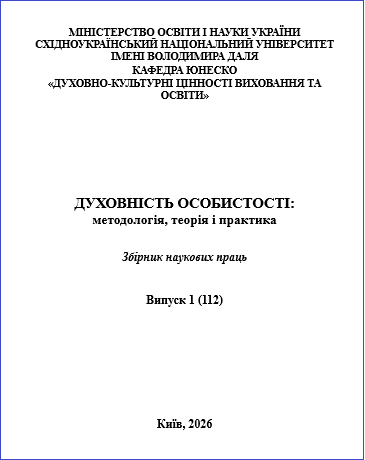
The evolution of conceptions of giftedness in twentieth-century western pedagogy
DOI:
https://doi.org/10.33216/2220-6310/2026-112-1-253-267Keywords:
giftedness, gifted education, Western pedagogy, evolution of conceptions, psychometric approach, cognitive-creative paradigm, multidimensional models of giftedness, human potential development, talent development, history of educationAbstract
The article presents a historical and pedagogical analysis of the evolution of conceptions of giftedness in twentieth-century Western pedagogy. It traces the transformation of scholarly approaches to giftedness from the psychometric interpretation, which viewed giftedness primarily as a measurable intellectual characteristic, to the contemporary concept of human potential development. Based on the analysis of the works of leading Western scholars, historical and pedagogical sources, and educational policy documents, five major stages in the evolution of conceptions of giftedness are identified: the psychometric stage (1900–1930), the institutionalization of gifted education (1940–1960), the cognitive-creative paradigm (1960–1980), multidimensional models of giftedness (1980–1990), and the transition to the concept of human potential development at the end of the twentieth and the beginning of the twenty-first century. The study demonstrates that each stage reflects a shift in the methodological foundations of giftedness research and a gradual expansion of the concept itself. It is argued that the psychometric approach established the scientific study of intellectual abilities, while the institutionalization of gifted education led to the development of specialized educational programs and public policies supporting gifted learners. The cognitive-creative and multidimensional paradigms further broadened the understanding of giftedness by incorporating creativity, motivation, and personal and sociocultural factors. The findings indicate that the late twentieth century marked a conceptual shift from identifying gifted individuals to investigating the processes through which abilities are developed. This transformation laid the foundation for contemporary concepts such as talent development, human potential development, and lifelong learning. The article concludes that the evolution of Western pedagogy reflects a transition from measuring abilities to creating educational conditions that foster the development and realization of every learner's potential.
References
1. Binet, A., & Simon, T. (1916). The Development of Intelligence in Children (The Binet-Simon Scale) (E. S. Kite, Trans.). Williams & Wilkins. [online] Available at:https://wellcomecollection.org/works/geby498b (Accessed 1 August 2026) (eng).
2. Bloom, B. S. (Ed.). (1956). Taxonomy of Educational Objectives: Handbook I. Cognitive Domain. David McKay. [online] Available at:https://archive.org/search?query=Taxonomy+of+Educational+Objectives+Bloom (Accessed 1 August 2026) (eng).
3. Bloom, B. S. (1985). Developing Talent in Young People. Ballantine Books. [online] Available at:https://books.google.com/books?id=_kCTEAAAQBAJ (Accessed 1 August 2026) (eng).
4. Borland, J. H. (2005). Gifted Education Without Gifted Children: The Case for No Conception of Giftedness. In R. J. Sternberg & J. E. Davidson (Eds.), Conceptions of Giftedness (2nd ed., pp. 1–19). Cambridge University Press. [online] Available at: https://www.cambridge.org/core/books/abs/conceptions-of-giftedness/gifted-education-without-gifted-children-the-case-for-no-conception-of-giftedness/EBDDF246D15052C3CF272022B3EAEEE1(Accessed 1 August 2026) (eng).
5. Dai, D. Y. (2016). Envisioning a New Century of Gifted Education. In Gifted Education in the 21st Century. Springer. [online] Available at:https://doi.org/10.1007/978-94-6300-503-6_3 (Accessed 1 August 2026) (eng).
6. Dai, D. Y., & Chen, F. (2013). Three Paradigms of Gifted Education: In Search of Conceptual Clarity in Research and Practice. Gifted Child Quarterly, 57(3), 151–168. [online] Available at:https://doi.org/10.1177/0016986213490020 (Accessed 1 August 2026) (eng).
7. Feldhusen, J. F. (1998). A Conception of Talent and Talent Development. In R. C. Friedman & K. B. Rogers (Eds.), Talent in Context (pp. 193–209). American Psychological Association. [online] Available at:https://psycnet.apa.org/doi/10.1037/10297-010 (Accessed 1 August 2026) (eng).
8. Freeman, J. (1992). Education for the Gifted in a Changing Europe. Roeper Review, 14(4), 198–201. [online] Available at:https://doi.org/10.1080/02783199209553428 (Accessed 1 August 2026) (eng).
9. Gagné, F. (2004). Transforming Gifts into Talents: The DMGT as a Developmental Theory. High Ability Studies, 15(2), 119–147. [online] Available at:https://doi.org/10.1080/1359813042000314682 (Accessed 1 August 2026) (eng).
10. Gardner, H. (1983). Frames of Mind: The Theory of Multiple Intelligences. Basic Books. [online] Available at:https://books.google.com/books/about/Frames_of_Mind.html?id=ObgOAAAAQAAJ (Accessed 1 August 2026) (eng).
11. Guilford, J. P. (1967). The Nature of Human Intelligence. McGraw-Hill. [online] Available at:https://books.google.com/books?id=Pe6wAAAAIAAJ (Accessed 1 August 2026) (eng).
12. Hollingworth, L. S., 1926. Gifted Children: Their Nature and Nurture. New York: The Macmillan Company. [online] Available at: Wellcome Collection [Accessed 3 August 2026] (eng).
13. Hollingworth, L. S. (1942). Children Above 180 IQ: Origin and Development. World Book Company. [online] Available at:https://archive.org/details/childrenabove18000holl (Accessed 1 August 2026) (eng).
14. Lo, C. O., & Porath, M. (2017). Paradigm Shifts in Gifted Education: An Examination Vis-à-Vis Its Historical Situatedness and Pedagogical Sensibilities. Gifted Child Quarterly, 61(4), 343–360. [online] Available at:https://doi.org/10.1177/0016986217722840 (Accessed 1 August 2026) (eng).
15. Pfeiffer, S. I. (Ed.). (2017). APA Handbook of Giftedness and Talent. American Psychological Association. [online] Available at:https://doi.org/10.1037/0000038-000 (Accessed 1 August 2026) (eng).
16. Renzulli, J. S. (1978). What Makes Giftedness? Reexamining a Definition. Phi Delta Kappan, 60(3), 180–184, 261. [online] Available at:https://doi.org/10.1177/003172171109200821 (Accessed 1 August 2026) (eng).
17. Stern, W. (1914). The Psychological Methods of Testing Intelligence (G. M. Whipple, Trans.). Warwick & York. [online] Available at:https://archive.org/details/psychologicalmet00steruoft (Accessed 1 August 2026) (eng).
18. Sternberg, R. J. (1985). Beyond IQ: A Triarchic Theory of Human Intelligence. Cambridge University Press. [online] Available at:https://books.google.com/books/about/Beyond_IQ.html?id=jmM7AAAAIAAJ (Accessed 1 August 2026) (eng).
19. Sternberg, R. J., & Davidson, J. E. (Eds.). (2005). Conceptions of Giftedness (2nd ed.). Cambridge University Press. [online] Available at:https://doi.org/10.1017/CBO9780511610455 (Accessed 1 August 2026) (eng).
20. Terman, L. M., 1916. The Measurement of Intelligence: An Explanation of and a Complete Guide for the Use of the Stanford Revision and Extension of the Binet-Simon Intelligence Scale. Boston: Houghton Mifflin Company. [online] Available at: Project Gutenberg [Accessed 3 August 2026] (eng).
21. Terman, L. M., Baldwin, B. T. et al., 1925. Genetic Studies of Genius. Vol. I: Mental and Physical Traits of a Thousand Gifted Children. Stanford, CA: Stanford University Press. Available at: Open Library [Accessed 3 August 2026]. (Accessed 1 August 2026) (eng).
22. Torrance, E. P. (1962). Guiding Creative Talent. Prentice-Hall. [online] Available at:https://archive.org/search?query=Guiding+Creative+Talent+Torrance (Accessed 1 August 2026) (eng).
23. Torrance, E. P. (1974). Torrance Tests of Creative Thinking: Norms-Technical Manual. Personnel Press. [online] Available at:https://worldcat.org/search?q=Torrance+Tests+of+Creative+Thinking (Accessed 1 August 2026) (eng).
24. Whipple, G. M. (1924). Classes for Gifted Children. Public School Publishing Company. [online] Available at:https://archive.org/details/classesforgifted00whip (Accessed 1 August 2026) (eng).
25. Terman, L. M., (1925) Genetic Studies of Genius. Vol. 1: Mental and Physical Traits of a Thousand Gifted Children. Stanford, CA: Stanford University Press. [online] Available at: Google Books [Accessed 3 August 2026] (eng).
26. Ziegler, A., Stoeger, H., Harder, B., & Balestrini, D. P. (2013). Gifted Education in German-Speaking Europe. Journal for the Education of the Gifted, 36(3), 384–411. [online] Available at:https://doi.org/10.1177/0162353213492247 (Accessed 1 August 2026) (eng).